There’s a quiet pattern you’ll notice if you spend enough time inside high-performing Australian organisations.
They don’t panic when something goes wrong.
They don’t scramble when systems fail.
They don’t point fingers when incidents surface.
They move.
Deliberately. Calmly. Decisively.
And when you dig deeper, you realise something important:
It’s not because they have better cameras.
It’s not because they have fancier control rooms.
It’s not because they bought the latest AI dashboard.
It’s because they built security culture.
And that changes everything.
1.) The Dangerous Myth: “We Installed the System, So We’re Covered”
Let’s address the elephant in the boardroom.
Too many companies believe that capital expenditure equals capability.
- Installed a new CCTV network? ✔
- Upgraded access control? ✔
- Signed a remote monitoring contract? ✔
- Passed compliance audit? ✔
Case closed.
Except it isn’t.
Because:
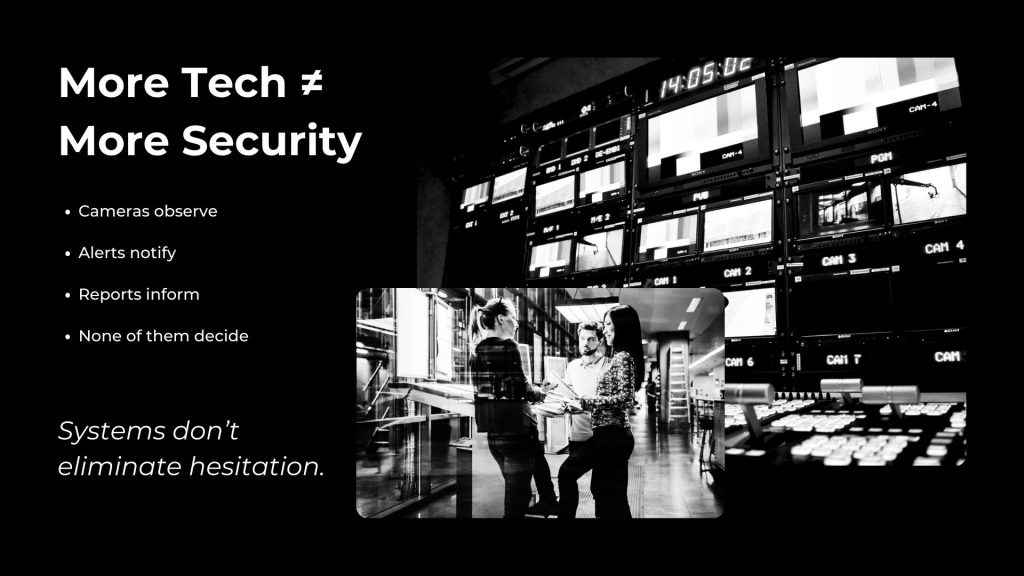
- Cameras observe — they don’t decide.
- Alerts notify — they don’t act.
- Reports inform — they don’t enforce.
The deciding factor is human behaviour.
And behaviour is shaped by culture.
If your staff ignore alerts because “it’s probably nothing”…
If supervisors hesitate because escalation pathways are unclear…
If executives only engage with security after an incident…
Then your expensive infrastructure is simply recording your failure in high definition.
Top Australian companies understand this truth early.
Security is not hardware.
Security is habit.

2. What Security Culture Actually Looks Like in Practice
Security culture is not a motivational poster in the break room.
It’s visible in the small decisions made daily across the organisation.
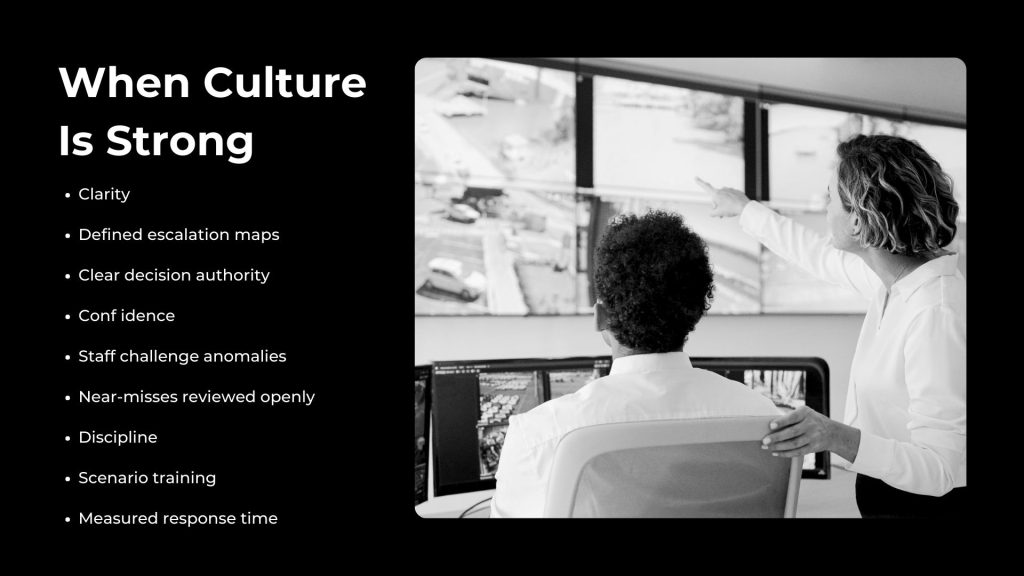
In strong security cultures, you will consistently see:
- Employees confidently challenging unknown visitors.
- Clear reporting channels that are actually used.
- Near-miss events documented and reviewed.
- Leadership openly discussing risk exposure.
- Cross-functional alignment between operations, HR, IT, and executive teams.
- Contractors held to identical behavioural standards as permanent staff.
In weak security cultures, you’ll see the opposite:
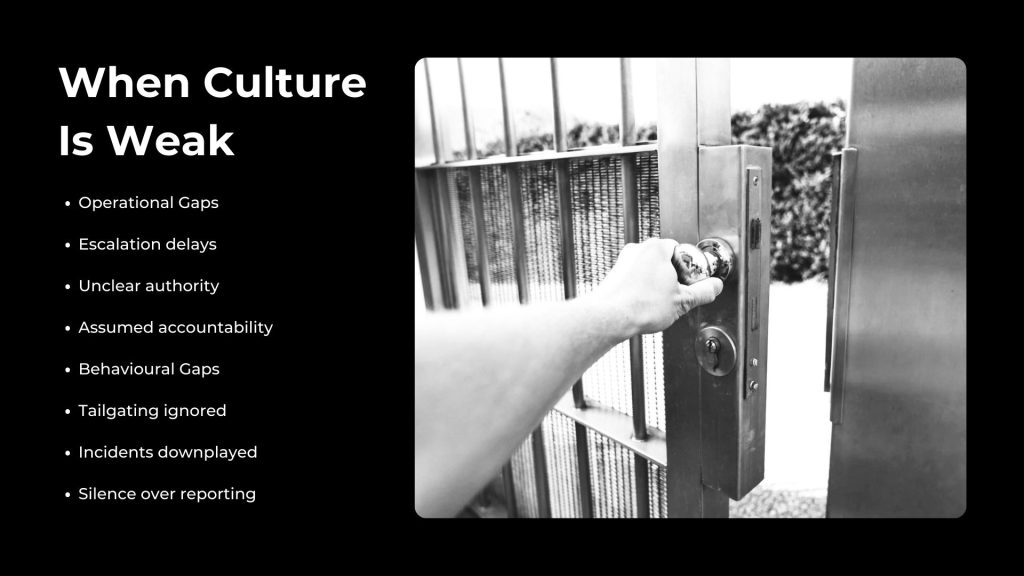
- Tailgating ignored because it feels awkward to speak up.
- Incidents downplayed to “avoid drama.”
- Departments operating in silos.
- Escalations delayed due to uncertainty.
- Blame assigned instead of accountability accepted.
The difference is not budget size.
The difference is behavioural clarity.
3. Why This Is Especially Critical in Australia
Operating in Australia comes with unique exposure layers:
- Geographically dispersed facilities across urban and regional areas.
- Heavy reliance on critical infrastructure networks.
- Increasing cyber-physical integration across logistics, utilities, and enterprise.
- High regulatory scrutiny and public accountability standards.
This environment does not reward reactive organisations.
It rewards prepared ones.
And preparedness is cultural before it is technical.
Australian organisations that operate in sectors such as:
- Commercial property
- Energy and utilities
- Logistics and transport
- Healthcare
- Corporate enterprise
cannot afford ambiguity during incidents.
Security culture reduces ambiguity.
It clarifies authority.
It accelerates response time.
It prevents hesitation.
4. The Compounding ROI Most Leaders Overlook
Security culture produces measurable financial outcomes — even if it doesn’t show up on a purchase order.
Organisations with strong security cultures often experience:
- Reduced internal shrinkage and asset loss.
- Faster containment during operational disruptions.
- Lower insurance claims and premium pressures.
- Improved compliance positioning during audits.
- Decreased legal exposure due to documented proactive behaviour.
- Greater employee confidence in workplace safety.
- Enhanced client trust during procurement processes.
But here’s the deeper layer:
The same discipline that strengthens security also strengthens operations.
Because security culture reinforces:
- Clear communication protocols.
- Defined decision-making authority.
- Rapid escalation pathways.
- Situational awareness across teams.
- Accountability without ego.
That discipline bleeds into everything.
Operational efficiency improves.
Crisis handling improves.
Reputation resilience improves.
This is why top-tier organisations treat security as a strategic function — not a background service

5. The Leadership Factor: Where Most Companies Get It Wrong
Security culture is not built by the security department alone.
It is built by leadership visibility.
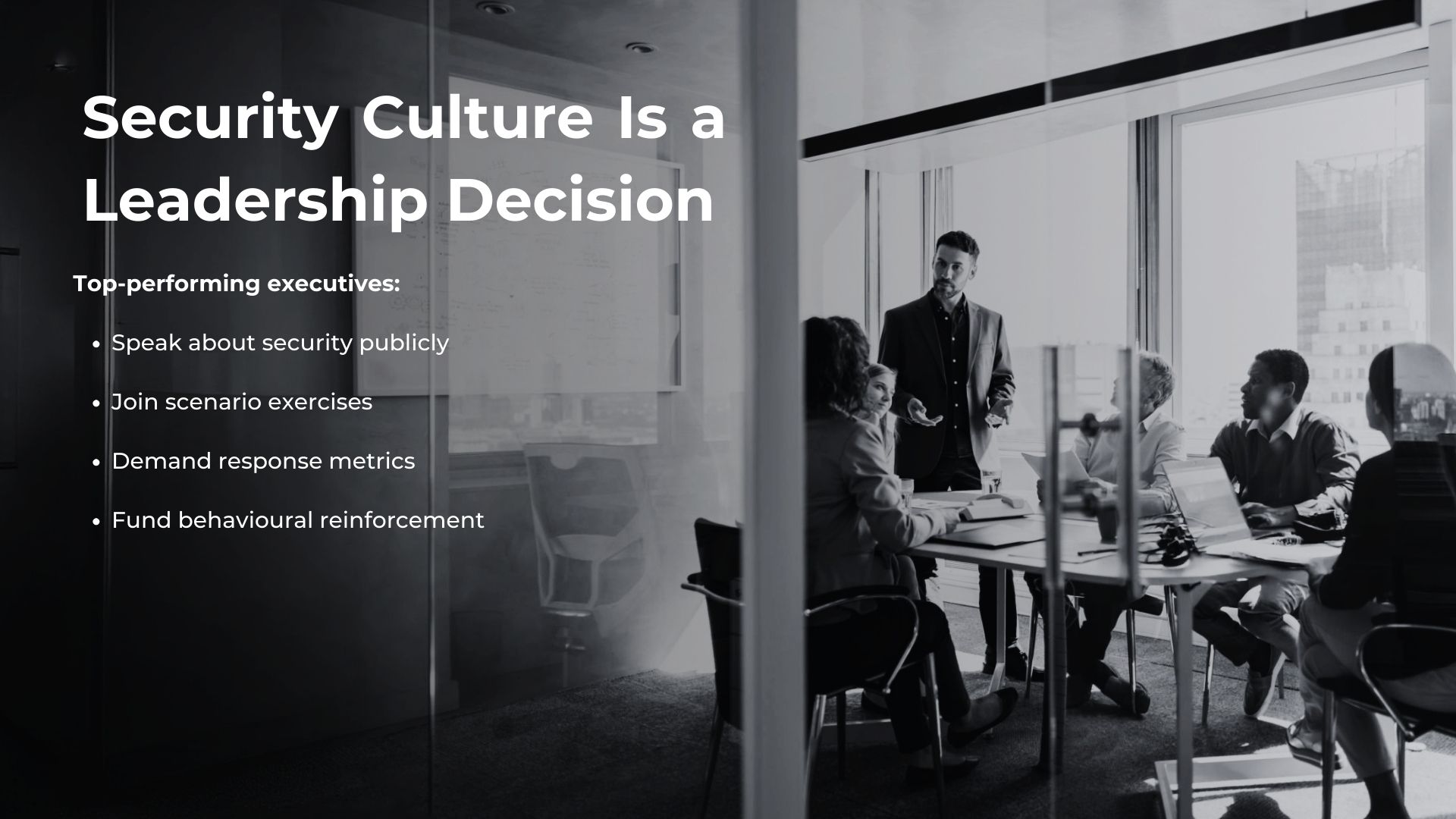
In high-performing organisations, executives:
- Publicly prioritise security in town halls and strategic updates.
- Participate in scenario exercises.
- Demand measurable response-time data.
- Hold managers accountable for compliance gaps.
- Fund ongoing behavioural training — not just system upgrades.
When leadership engagement is absent:
- Security becomes reactive.
- Budget discussions focus only on cost, not exposure.
- Operational teams receive mixed signals about importance.
If leadership treats security as secondary, so will everyone else.
Culture mirrors priority.
Every time.
6. The People + Process + Technology Alignment Model
The most effective security cultures operate in this order:
- People
- Training
- Awareness
- Confidence
- Ownership
- Training
- Process
- Clear escalation maps
- Defined authority thresholds
- Incident documentation standards
- Cross-functional coordination
- Clear escalation maps
- Technology
- Surveillance systems
- Access control
- Monitoring platforms
- Data analytics
- Surveillance systems
When technology is implemented before behavioural clarity:
- Alerts overwhelm teams.
- Systems get bypassed.
- Workarounds become normalised.
When people and process lead:
- Technology enhances performance instead of complicating it.
- Data becomes actionable.
- Response becomes instinctive.
Technology amplifies culture.
It does not replace it.
7. Cameras Don’t Create Courage
Let’s strip this back to basics.
When an incident occurs, three questions determine outcome speed:
- Who has authority?
- Who makes the call?
- How fast is the decision executed?
If any of those answers are unclear, delay happens.
Delay increases exposure.
Exposure increases cost.
Cameras cannot eliminate hesitation.
Only training, clarity, and reinforcement can.
Strong security cultures eliminate guesswork by:
- Defining responsibility in advance.
- Running scenario drills under pressure.
- Reviewing performance metrics post-incident.
- Adjusting process gaps continuously.
Confidence is built through repetition.
Repetition builds speed.
Speed protects value.
8. How to Build Security Culture Intentionally
For organisations serious about turning security into strategic leverage, the roadmap is clear:
- Make Security Visible at the Top
- Public executive endorsement.
- Board-level reporting alignment.
- Define Behavioural Standards
- What does “good security behaviour” actually mean?
- What actions are non-negotiable?
- Institutionalise Scenario Testing
- Tabletop simulations.
- Live drills.
- Cross-department exercises.
- Track What Matters
- Incident response times.
- Escalation delays.
- Near-miss frequency.
- Create Psychological Safety Around Reporting
- No retaliation.
- No embarrassment.
- No silence culture.
Security culture is not built through fear.
It is built through clarity and repetition.
9.The Competitive Advantage No One Advertises
Here’s what most companies miss:
Clients may never see your internal systems.
But they feel your discipline.
They feel your preparedness.
They feel your confidence under pressure.
A strong security culture signals:
- Organisational maturity.
- Leadership alignment.
- Operational reliability.
- Risk awareness without paranoia.
In competitive tenders and high-trust industries, that signal matters more than ever.
Because partners don’t just evaluate capability.
They evaluate resilience.
9.Final Thought
Security culture is quiet.
It doesn’t make headlines when it works.
But when it’s absent, it absolutely does.
Top Australian companies understand that security is not a line item.
It is strategic control.
And control, in business, compounds.
Build the culture first.
Then let the technology amplify it.